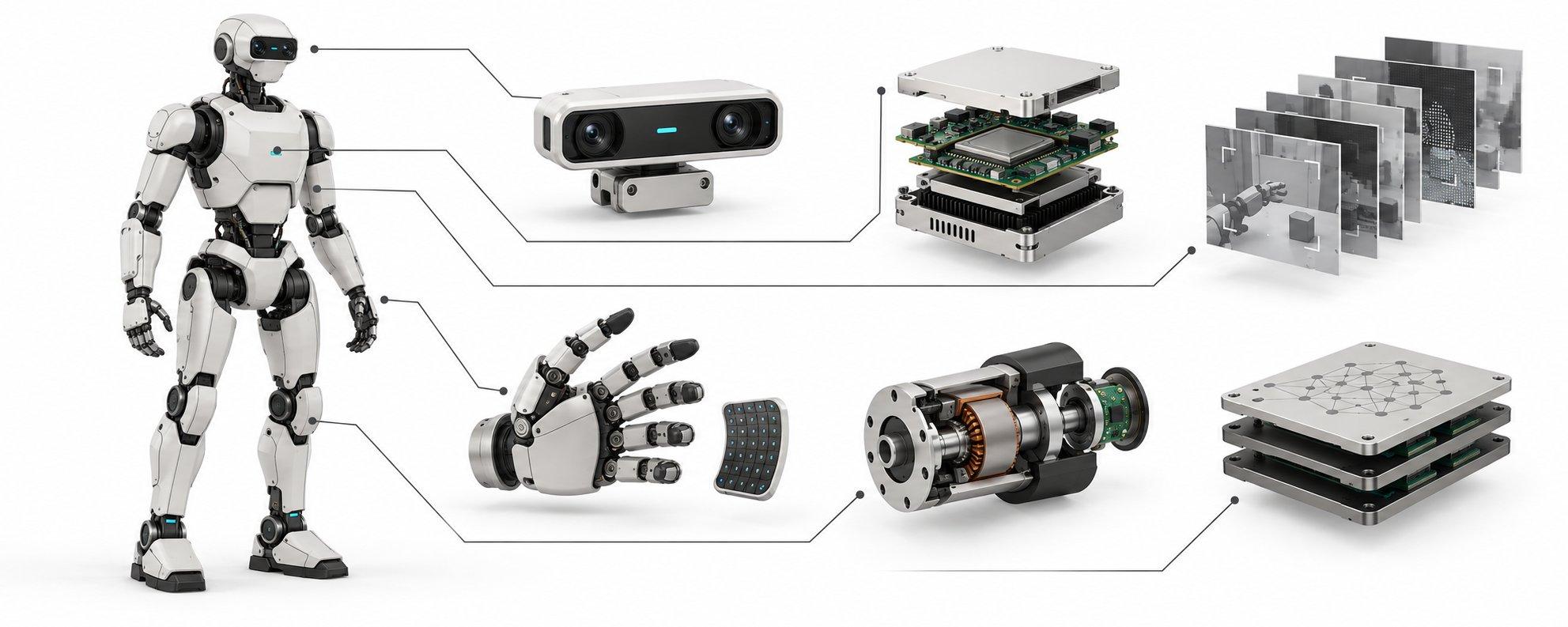
Over 100,000 parts make up a machine with levitating parts. Arguably one of the most complex devices humans have ever assembled.
ASML’s EUV lithography machines sit at the heart of advanced semiconductor manufacturing. And yet, without what happens upstream and downstream, their extraordinary precision produces something relatively useless.
Upstream, you need a chip design, translated into the patterns the machine projects onto a light-sensitive coating on the wafer. Downstream, other machines develop that coating, etch the underlying material, deposit new layers, and modify the silicon’s electrical properties.
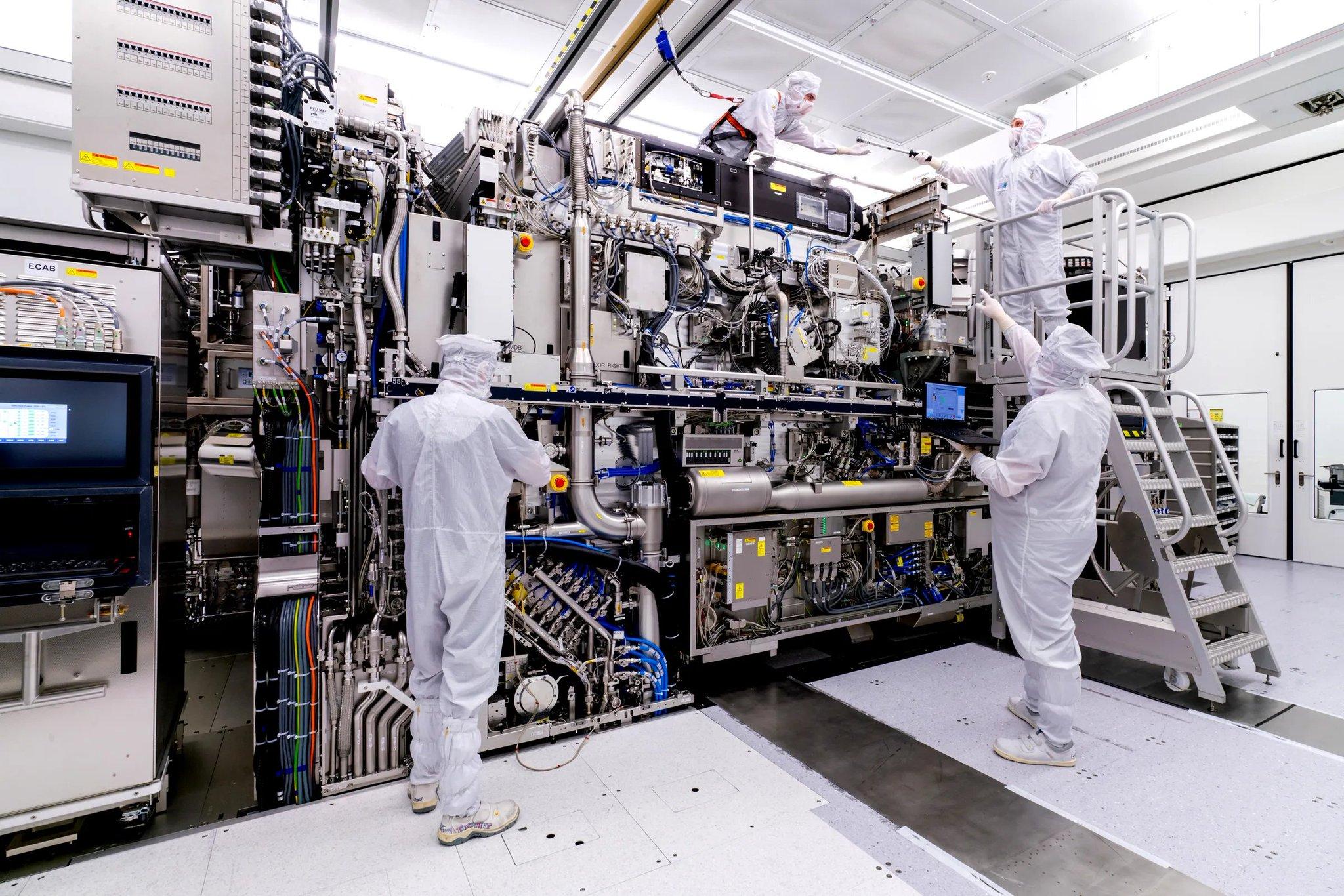
These machines epitomize coordinated specialization. In 2012, Intel, TSMC, and Samsung agreed to contribute €1.38 billion to fund ASML’s next-generation lithography technologies. Each company would still develop its own products and manufacturing processes, but without the overhead of building its own lithography machines.
ASML may be an extreme example, but it raises an important parallel for the generalist robotics industry:
Which specialized capabilities can serve many different embodiments? And where development requires close coordination with other parts of the stack, does that imply internalization?
These are economic questions as much as they are research questions. But the uncertainty about their answers is the invisible force pushing every company towards a full-stack approach. And while verticalization leads to more defensible value accrual, it also pushes companies towards work duplication and early commitments to untested architectures.
The Verticalization Pressure#
Robotics has well-defined market boundaries. Particularly in supply chain: Actuators, batteries, cameras, magnets, and other components come from specialized suppliers.
Software specialization also exists. Virtually everyone in the industry uses either MuJoCo or Isaac Sim as their simulation engine. A team can develop its own hardware and control policies while relying on a shared physics engine to test them.
But for the emerging field of generalist robotics, the boundaries around intelligence, sensing capabilities, architectures, and behavior are much less settled.
In a previous essay I described an hourglass-shaped robotics industry, with much of the attention concentrated at two ends: the big robotics labs and the data providers.
The hourglass is also a helpful visualization of the intelligence value chain in robotics: Everything needed to turn an hour of collected data into a successful policy in a deployed embodiment.
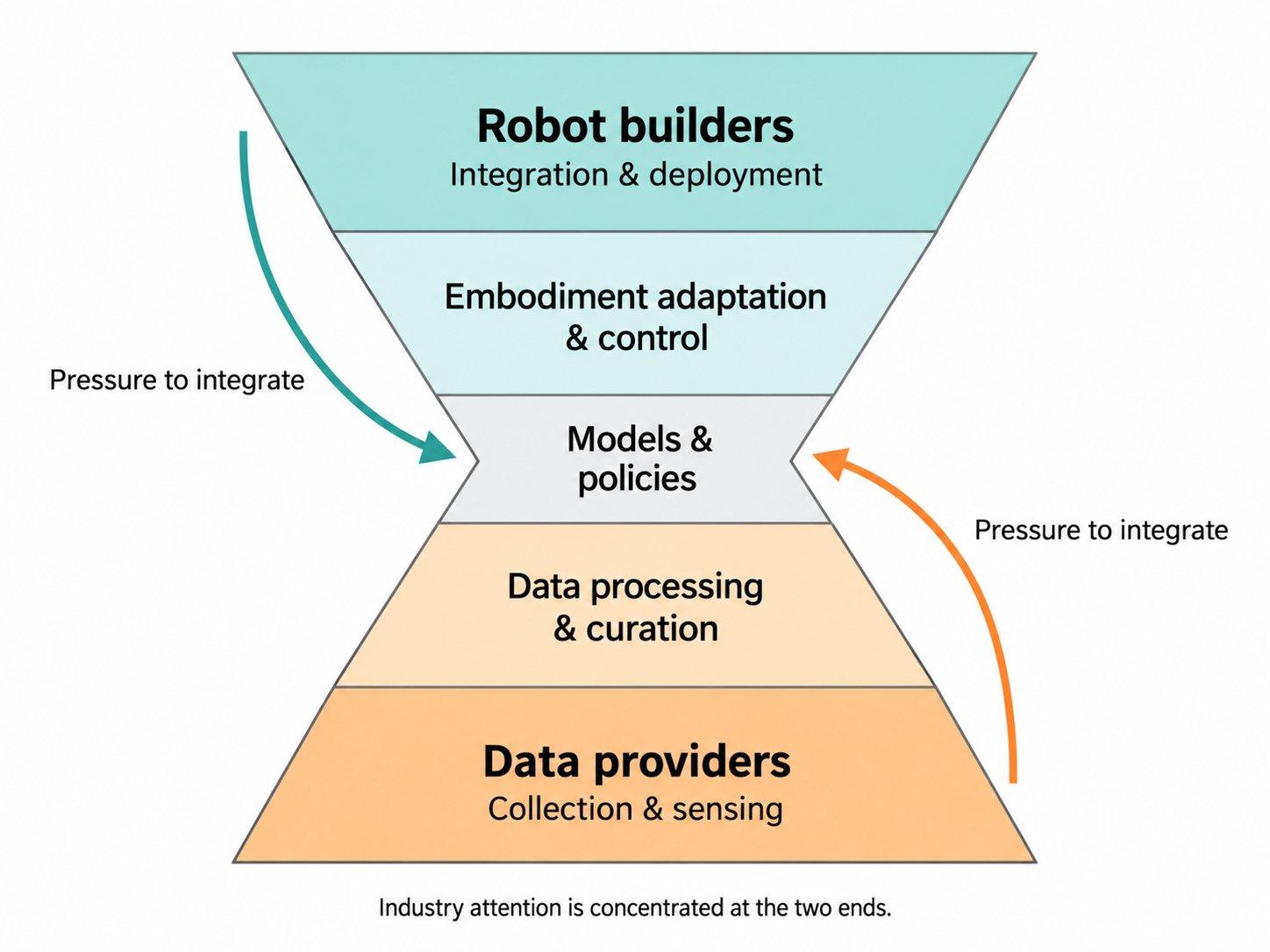
At each end of this shape, there is significant market pressure to expand to other parts of the stack. For robot builders, this means taking responsibility for more of the intelligence that controls their hardware.
In February of 2025, @adcock_brett announced the end of their collaboration with OpenAI to bring intelligence in-house, followed by the Helix announcement two weeks later.
Introducing Helix, our newest AI that thinks like a human
To bring robots into homes, we need a step change in capabilities
Helix can generalize to any household item 🧵
A few months ago, @BerntBornich also announced the creation of 1X's in-house world model lab.
We’re going all in on World Models.
Today we’re launching the 1X World Model Lab.
The bet is simple:
You can’t fine-tune your way to AGI.
And you definitely can’t fine-tune your way to robots that can operate in the physical world.
General-purpose humanoids need models that…
And once you internalize intelligence development, a strong incentive to also internalize data collection appears, as @Figure_robot's Index shows.
Introducing Index
Today we're coming out of stealth with the largest and most diverse robot dataset to scale general purpose robots
To date we've crossed 264,000 app downloads and uploaded 16 million videos
I spoke at length about how brittle the moats around egocentric data are in my previous essays. But even in one of the bets I call out as a path forward for data companies - low-level tactile sensing - the pressure to move up the stack is also there.
A recurring theme in many recent conversations with tactile founders is the difficulty in separating their data's value from its downstream usage. And by extension, the need to have access to the hardware to validate it.
If you make tactile sensors, there is pressure to build the skin that integrates them. If you build the skin, there is pressure to build the glove that collects the data. If you build the glove, there is pressure to build the robotic hand that proves the data is useful. Then the arm that gives the hand its needed ROM. And once you have the arm, you might as well build the robot.
If you make tactile sensors, there is pressure to build the skin that integrates them.
Each step in isolation has a reasonable justification. Taken together, they can pull a specialized sensing company toward becoming another full-stack robotics company.
The Bets of Verticalization#
Underpinning this pressure to verticalize is an unresolved disagreement among researchers on what generalizes embodied capabilities. Or at least how to do it reliably and economically.
Roboticists often ask when the field will get its "GPT-3" moment. This question is ultimately about what will usher robotics into an LLM-like scaling paradigm. When will the field converge towards a working, generalizable architecture where increasing data and compute produces predictable improvements?
@Xiao_ted's comment on @Peteflorence is spot on here.
Robotics pre-training *from scratch* has been a heretical idea for the last two years. That “there’s no internet of robotics data” has led to two prevailing conclusions: 1) we need to use pretrained model backbones and 2) we need to scale robotics data.
The first conclusion in…
Pete Florence @peteflorence · Apr 7
Going Beyond World Models & VLAs
There is broad agreement that new robotics training data matters. And, interestingly, significant market specialization has emerged to meet it. But there is much less agreement on which data to collect, how to combine it, or which model architectures will best use it.
For specialization, the question goes beyond model architectures. Fundamentally, specialization asks how much of an improvement in an embodied capability carries over to another company’s robot, and how much has to be rebuilt around a particular embodiment and sensor stack?
Take the forest of end-effector design options, for example. @maxtitovvv's essay is a good tour of the possibilities.
Takes on end effectors are too binary. People love to claim: "grippers are better than hands!" "tendons are superior!" or "direct drive wins." But its much more nuanced than that...
The rabbit hole of end effector design
Even among hands, the design options are vast. Directly driven joints or tendon-driven fingers? 3 digits plus a thumb? Two thumbs? 3DOF per finger or more? Or even more esoteric bets like Tom Zhang's @DaxoRobotics infinite DOF hand. Gripper designs also have a similarly diverse range of possibilities.
Introducing Muscle v0 -- infinite degrees of freedom, from @DaxoRobotics. A different mountain to climb - with a far more beautiful peak.
We built this from the ground up:
- Ultra-dexterous
- Built for machine learning
- Durable and robust
More below (1/n)
I doubt that any of these approaches is fundamentally incompatible with general dexterity. But compatibility or feasibility are not the problem. Viability is.
Can your hand learn from the growing corpus of egocentric human video? Can skills learned on a five-fingered hand transfer to a three-fingered gripper cheaply? How much custom control is needed underneath a general-purpose physical reasoning model?
Those answers determine not only the practicality of a given design, but also the viability of an independent business. They determine how many customers a specialist can serve, how much adaptation each deployment requires, and whether that work leaves enough margin to sustain the business.
While those answers remain uncertain, companies making these early bets will continue to feel a pressure to verticalize across the stack.
The Coordination Trap of Robotics#
Any single company has a business incentive to own every part of the robotics stack. This leads to smoother integration among its layers, reduces external dependencies, and increases the company's market capture. The choice to verticalize is also obvious when the capabilities they need cannot reliably be bought, as is the case today.
But each additional layer becomes another business you have to be good at. A sensing company that starts building hands now has to divide its engineering effort between improving its sensors and making a reliable manipulation system.
A robot builder developing its own models and data ops now has to be responsible for difficult research questions in distinct fields, and the operational overhead of data collection that I know too well.
In isolation, these are sensible business choices to make given the state of the intelligence supply chain. But the cost appears when you look at the industry as a whole.
Some duplication is useful: competing approaches help establish which architectures work. But there is also a cost when each company has to rebuild capabilities that could serve many others.
On the flip side, betting to become the specialist while every other potential partner continues to build in-house is risky.
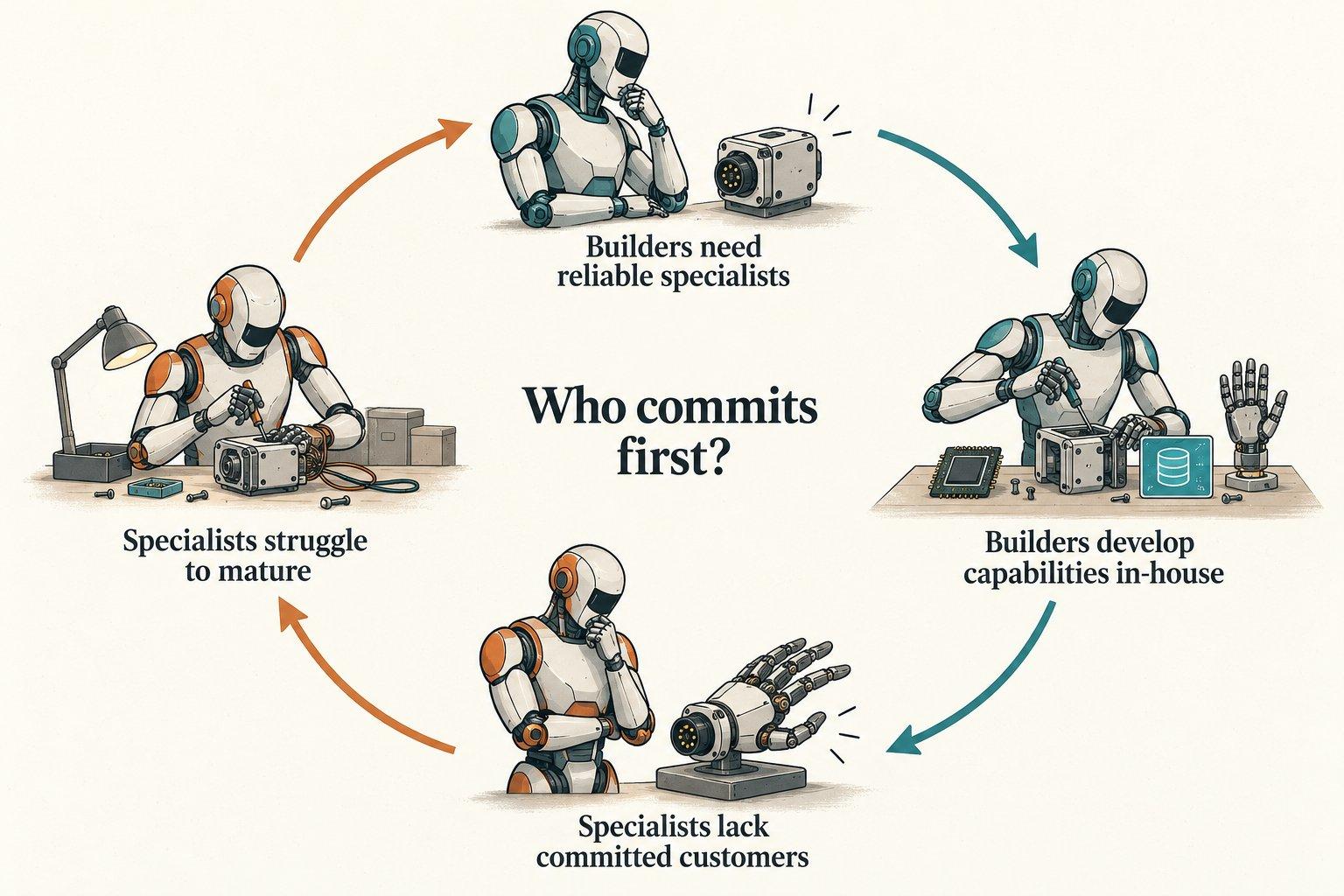
This creates a coordination trap. Specialists need customers willing to depend on them. Robot builders need specialists whose capabilities are already reliable enough to depend on.
Both sides could benefit from specialization, but neither wants to commit before the other is ready.
Parting Thoughts#
Some companies are already betting that these boundaries will solidify.
@perceptroninc is building perception and reasoning capabilities that operate through different embodiments’ tools. @physical_int is developing models with companies like Weave and Ultra, which deploy them on their own robots.
That brings me back to ASML. Its customers didn't need lithography R&D to become entirely independent of the rest of industry. They needed a specialist they could coordinate with, invest in, and depend on.
Generalist robotics still has to discover its own version of those relationships and market dynamics. Some boundaries will require ongoing research coordination, like PIs' close partnerships. Others can likely stand on pure commercial agreements - specialized data collectors being arguably the best example here.
The risk is that the temporary necessity to build every part of the stack in-house becomes a permanent assumption, slowing the entire field down.
A chicken-and-egg problem:
Every company builds internally because the specialists are not ready, while specialists can't invest in becoming ready because the customers keep building internally.
The eventual shape and timeline for meaningful generalist robotics deployment will depend on the way this causality loop evolves.
I care about how quickly the field advances, and I want more companies to be able to build on one another’s work.
I want specialized coordination.
I want a future of decoupled robotics.